
Dance and meditation have been intertwined for me since I began practicing.
Photo by Eli Hill, 2022
Somatic Meditations
Moving meditations for resilience, vitality, and ease in the body.
These simple practices are rooted in dance and informed by somatic traditions such as Qi Gong, Noguchi Taiso, Body-Mind Centering, and Butoh.
They can help release chronic tension and pain, support a sense of embodied wellbeing, and invite the exploration of Samatha–Vipassana in movement.

Somatic Meditations
In this course, you will learn to practice Vipassana meditation over 8 weeks, following the Buddha’s instructions.
Vipassana means to see clearly — to develop insight — and it brings about a profound transformation in how we experience ourselves and the world.
The Satipatthana Sutta is the foundational text on which this practice is based. It outlines a systematic cultivation of mindfulness and the development of faculties that lead to awakening.
The Course
This course runs over 8 weeks. You are encouraged to practice 30–90 minutes of daily meditation. We meet live every Thursday at 4pm WEST (UTC+1, London) for two hours, and you will be assigned to a small practice group that meets independently once a week.
Each week also includes short video lessons and a WhatsApp group where you can share a weekly meditation report.
The guiding principles of the course are:

Practice
This is your own practice of mindfulness, both formal and informal (off the cushion). Your direct experience is the foundation for developing insight. Applying yourself and putting in the time is essential for progress.

Learning
By engaging with the material — reading, listening, reflecting, asking questions, and discussing — we develop a clear understanding of how to practice. This helps us practice intelligently, not just intensively.

Feedback
Reporting on your practice and receiving feedback — from the teacher, other practitioners, and your own reflections — allows you to iterate, learn quickly, and refine your approach. This supports greater precision, clarity, and motivation.
A week during the course

Live Sessions
Live meetings with the teacher and the full group.
Q&A, new topic introductions, practice instructions, and meditating together.
9 sessions in total, from April 30 to June 25
Every Thursday, 4–6pm WEST (UTC+1, London)
Berlin: 5 PM
New York: 11 AM
California: 8 AM
India: 8:30 PM

Video Lessons
Each week includes two to three short (10-minute) lessons.
They introduce the Satipatthana Sutta, key principles, and how to apply them in your practice.

Practice Pod
A weekly meeting in a small group of 3–4 participants in a similar time zone.
A space to share how your practice is going, reflect together, and support each other.
A smaller feedback loop to help you see your practice more clearly, learn from others, and stay engaged with the challenges and joys of daily meditation.

Meditation Report
A short report shared every Sunday in a WhatsApp group.
An opportunity to receive feedback from the teacher, clarify your own practice through writing, and learn from others’ experience.
Weekly Topics
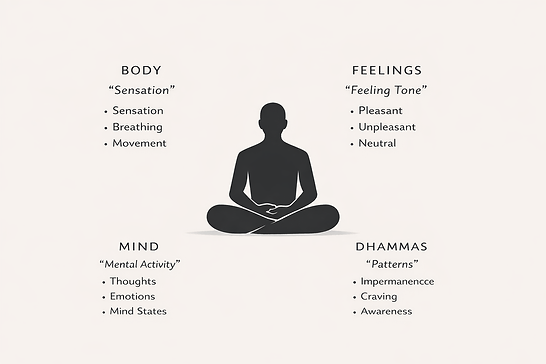
We begin with a re-introduction to Vipassana meditation and the core skills of Samadhi (concentration) and Sati Sampajanna (mindfulness with clear comprehension). From there, we move step by step through the four foundations of mindfulness as outlined in the Satipatthana Sutta — Body, Feeling Tone, Mind, and Dhammas.
In the final part of the course, we apply mindfulness more directly to the three characteristics of experience: Impermanence, Non-Self, and Suffering.
Orientation & Mindfulness of Breathing
Practicing Samadhi (concentration)
Posture & Sensation
Practicing Vipassana (insight) and Sati (mindfulness)
Body Foundation
Mindfulness of the body in daily life
Feeling Tone (Vedanā)
Mindfulness of feeling tone and emotions
Mind (Citta)
Mindfulness of mind states and verbal thought
Dhammas & Impermanence (Anicca)
Mindfulness of the fluxing, flowing nature of experience
Mindfulness of visual thought
Dhammas & Dissatisfaction (Dukkha)
Mindfulness of incongruence and resistance in experience
Dhammas & Non-Self (Anattā)
Mindfulness of the self as contraction, as tightening
Review & Integration
Putting the practice into context
Course Requirements
Daily Practice
Create the space and time for your daily meditation (30–90 minutes).
In this longer course, you will be guided less than in the 10-day course. Weekly instructions explain the technique, but you are expected to practice independently, using a timer rather than guided meditations.
This is crucial for developing your own “internal guide” and becoming a self-reliant meditator.
Weekly Live Sessions (2h)
Attend live or watch the recording.
These sessions help you understand why and how we practice. Right understanding is the foundation of good practice, supporting you in adjusting it based on its principles.
Practice Pod (1h weekly)
Meet with your small group to share and reflect on your practice.
Weekly Meditation Report (Sunday)
Share a short report in the WhatsApp group (~10 minutes).
5 questions on your practice, challenges, and insights.
What is not required
You don’t need a specific meditation posture or to sit cross-legged — a chair is completely fine.
You don’t need to maintain Noble Silence. This course is designed to fit into daily life. The value is learning to practice Vipassana within your life, not outside of it.
More about the Technique & Lineage
This course teaches the basics of the “Noting” technique, as popularised by Mahasi Sayadaw (Burma, 1904–1982).
It is one of the two main contemporary Vipassana approaches, alongside body-scanning, popularised by S.N. Goenka (Burma, 1924–2013).
The noting technique was further brought to the West through Sayadaw U Pandita and teachers such as Joseph Goldstein, Sharon Salzberg, Daniel Ingram, and Shinzen Young.
In noting, we use simple mental labels to recognise and clearly see what is arising in experience — breathing, hearing, sitting, thinking, remembering.
There are no distractions. Whatever arises, when seen clearly, becomes part of the practice.
The mental noting technique is a direct and effective way to establish mindfulness and bare awareness in the present moment.
It includes all sensory experience: body sensations, sights, sounds, smells, tastes, and thoughts.
The Progress of Insight
The Progress of Insight is a traditional Buddhist map describing the unfolding of insight in Vipassana meditation. It points to a shift from a more gross, conceptual sense of solidity to a fine-grained, direct knowing of experience — and ultimately, to the first awakening.
We use this model as a gentle map to support your process as insight deepens. While simply “being present” is central to the practice, this framework can help you orient, recognise patterns, and understand how to continue.
The original model describes 16 stages (ñāṇas, or “knowledges”).
In this course, we use a simplified version based on a contemporary model, The Insight Development Process (Grabovac et al., 2026). This model draws on the traditional stages and integrates perspectives from cognitive science, psychiatry, and neuroscience.
The 8-stage model describes the unfolding of insight as practice begins to deconstruct sensory experience. It moves through stages such as the knowledge of arising and passing (4th ñāṇa) and into deeper equanimity (11th ñāṇa).
A diagrammatic representation of momentary insights associated with each Insight Stage (Grabovac et al., 2026)

The full paper can be accessed below:
Grabovac, A. D., Grabovac, N., Yang, W. F. Z., Haggerty, M., Wright, M. J., & Sacchet, M. D. (2026).
The Insight Development Process: A Theoretical Framework for Stages of Advanced Insight Meditation
Your Facilitator

Reimar is a meditation teacher, dance facilitator, and father, currently based in Portugal, with over five years of teaching experience.
He began practicing meditation during his studies at Melbourne University, where he discovered Vipassana as a way to transform his relationship to stress, anxiety, and a lifelong struggle with eczema.
Experiencing its benefits early on, he committed to daily practice and intensive silent retreats in the tradition of S. N. Goenka, while working full-time at Vanguard.
He later moved to Thailand to deepen his practice, training in the Ajahn Tong-style Mahasi method. During this time, he completed multiple 12- and 16-day retreats, including intensive day-and-night meditation periods.
Reimar trained for four months under Ajahn Puttar at Wat Sopharam monastery in Northern Thailand, where he was authorised to teach. In total, he has spent over 30 weeks in intensive silent retreat.
His work is grounded in meditation, somatic, and artistic practice, including dance improvisation and martial arts.
He continues to refine his understanding, currently studying non-dual Vipashyana with Michael Taft.
In 2021, he founded vipassanathome.org, where he offers online courses and in-person retreats, sharing a balanced and integrated approach to meditation and life.